Agentic Sales Workflow — AI Forecasting & Market Insights
n8n · Groq LLM · Custom Regression Forecasting · Multi-Channel Reporting
01The challenge
A sales team needed market insights, demand forecasting and stock alerts, but every one of those depended on somebody sitting down to build a report. Anything that requires a person to remember to run it eventually stops getting run, and low-stock situations were being noticed after they had already cost a sale.
02The data problem
The inputs were scattered and unstructured: market and competitor pricing signals only existed on Amazon product listings, sales history sat separately from stock levels, and requests from the team arrived as free-text questions rather than structured queries. There was no forecasting logic anywhere and no mechanism to decide which of several different reports a given question actually needed.
03My approach
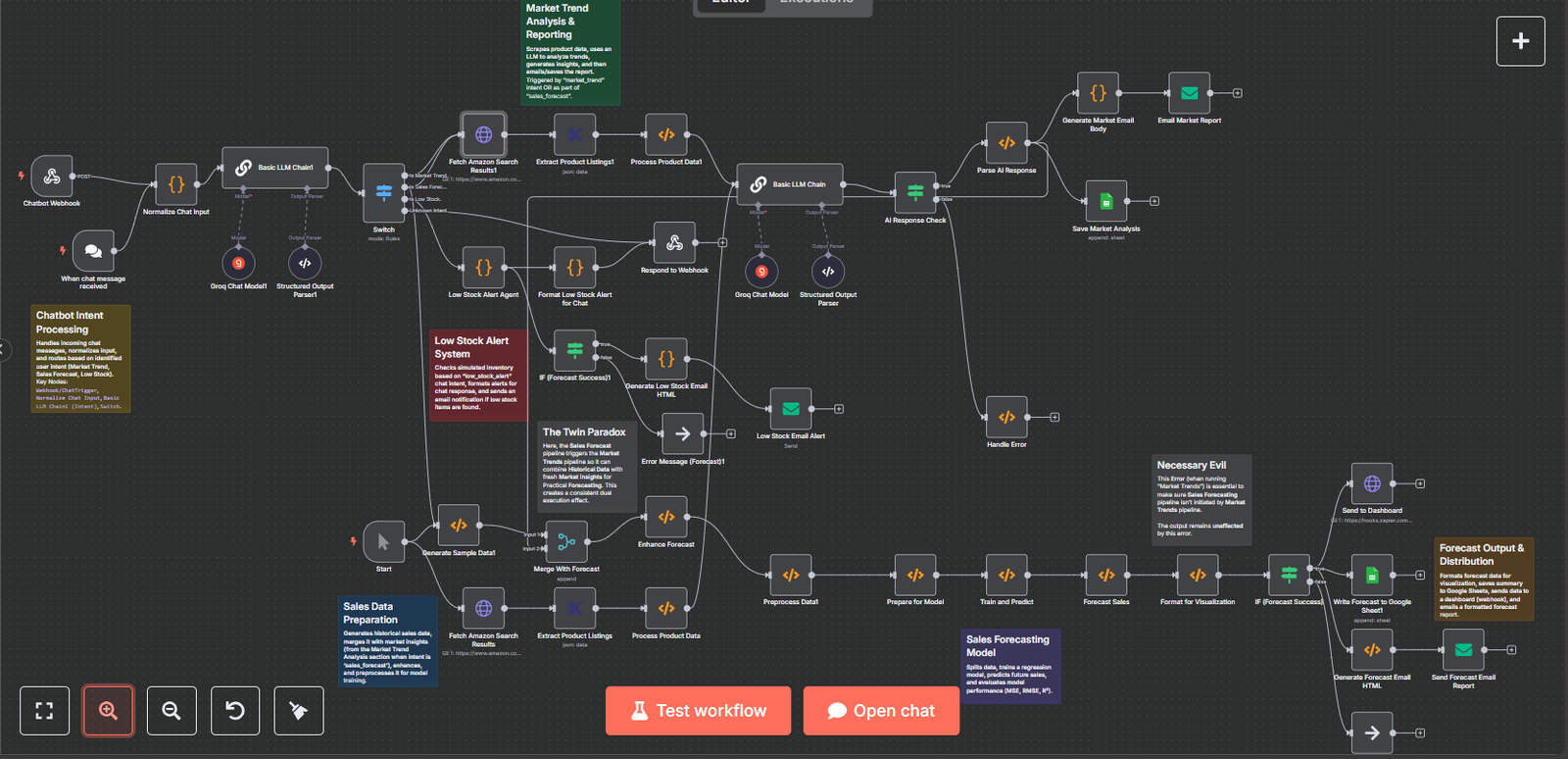
I built an Agentic Sales Workflow in n8n using a Groq LLM for intent recognition, so a plain-language request from the team is classified and routed to the right branch of the workflow instead of requiring a fixed command syntax. This intent-routed architecture is what makes one workflow able to serve several different jobs.
For market context I built Amazon market trend scraping to pull live competitor and pricing signals, and for forecasting I implemented a custom Gradient Descent regression model over sales history rather than relying on a black-box service, so the forecast logic is inspectable and tunable against the client's actual data.
The workflow also runs proactive low-stock alerts, firing before a shortage becomes a lost sale rather than reporting it afterwards. Output is delivered on whichever channel suits the moment — chat for quick questions, email for scheduled summaries, and Google Sheets for anything the team wants to work with directly.
04The result
The team gets forecasts, market insight and stock warnings without anyone building a report. Because intent recognition sits at the front, a single workflow answers a range of questions in plain language, and the proactive alerting turns stock management from a reactive scramble into something handled before it becomes urgent.
Tools & tech stack
- n8n: agentic workflow orchestration with intent-based routing
- Groq LLM: natural-language intent recognition for incoming requests
- Amazon market scraping: live competitor and pricing trend signals
- Custom Gradient Descent regression: inspectable sales forecasting model
- Proactive alerting: threshold-based low-stock warnings
- Multi-channel delivery: chat, email and Google Sheets reporting
Have data that isn't telling you anything yet?
Send me what you are working with — even if it is four spreadsheets and a CRM export that don't agree with each other.